
Advancing reproductive health together with young women
Global insights from three women working across sexual and reproductive health, rights, and menstrual wellbeing
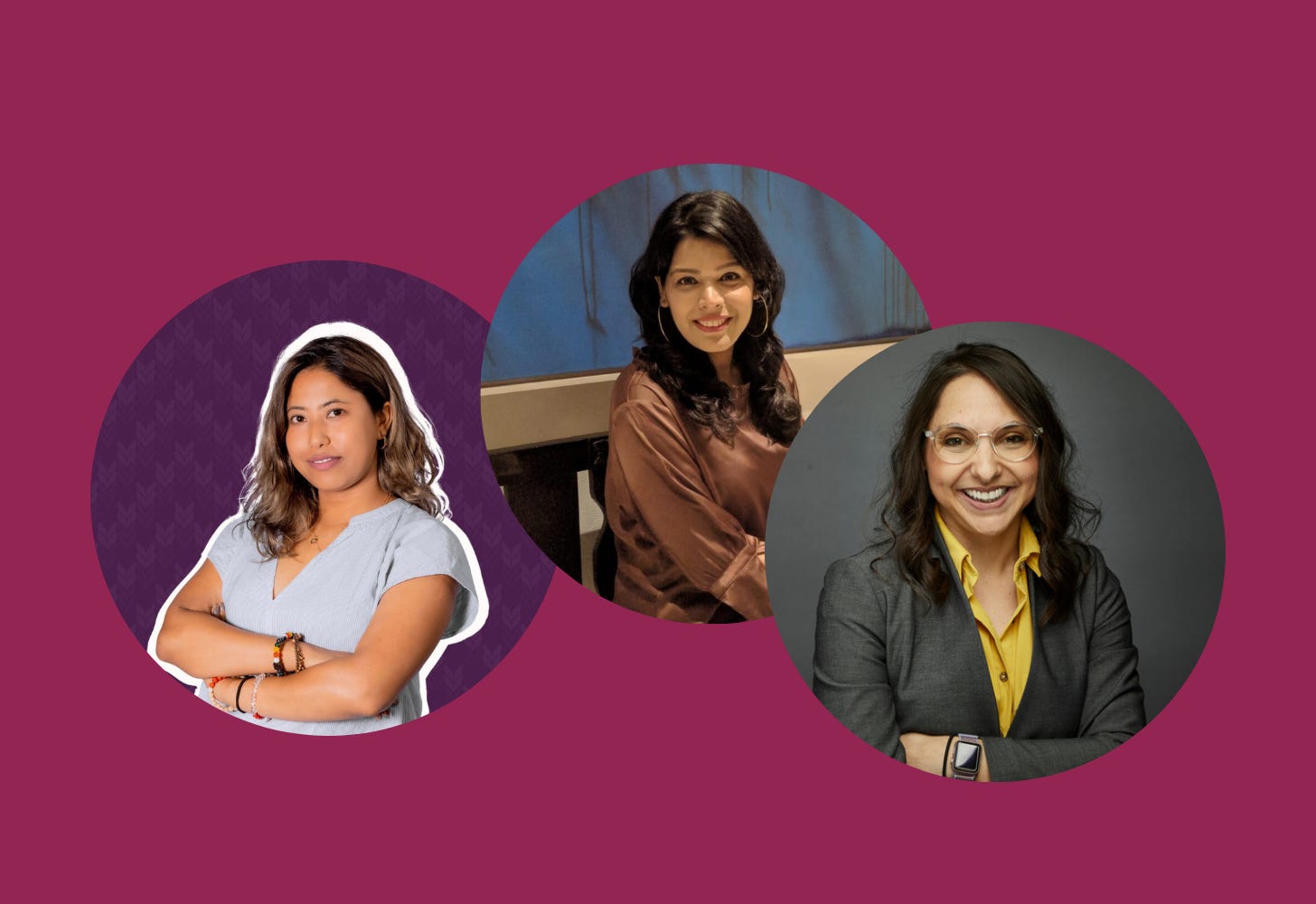
Left to right: Pushpa Joshi, Sharmin Kabir and Lauren Gerchow
Pushpa Joshi is a social innovator in Nepal advocating on sexual and reproductive health and rights, menstrual wellbeing and gender equity. She is a cofounder of YoSHAN (Youth-led SRHR Advocacy Nepal) supporting young people in all their diversity to thrive together and protecting the right to bodily autonomy through discourse and actions on sexuality.
Sharmin Kabir is a social entrepreneur in Bangladesh who founded Wreetu – an organization focusing on gender equity and menstrual wellbeing for adolescent women. They created the first-ever complete comic book on puberty and menstrual hygiene in Bangla that is supporting millions of girls and their communities to change their period narratives.
Lauren Gerchow is a US-based Sexual and Reproductive Health Researcher & Community and Public Health Nurse. During her PhD in Nursing at NYU, Lauren engaged adolescent mothers in NY City through ethnographic interviews, participatory activities and co-design workshops to identify gaps in sexual and reproductive health education and care, and develop services that respond to their needs.
What kinds of challenges do you see being faced by young women in regards to reproductive health, education and rights?
Pushpa Young women in Nepal and across the world continue to face stigma, misinformation and limited access to comprehensive sexuality education and youth-friendly services, all rooted in deeply entrenched structural inequalities. Their autonomy is systematically restricted by patriarchal systems that seek to control their bodies, sexuality and choices. These barriers are even more severe for those at the intersections of marginalization — including queer individuals, young women with disabilities and women from marginalized castes.
Sharmin Challenges for young women in Bangladesh include lack of awareness due to the unavailability of trustworthy information, poor or no psychological support from family, school and society and cultural and religiously stigmatized social systems.
Lauren In the United States, reproductive rights are under sustained attack, and young people are often the first group targeted when access to sexual and reproductive health care or sex education is restricted. The specific challenges young women face vary across countries (shaped by culture, language, and health system structure) but the theme is consistent — girls and women everywhere encounter sexism and gendered expectations that constrain their health, safety, and self sufficiency.
What got you started working in this field?
Pushpa Growing up, I constantly questioned the discrimination and injustice directed toward girls and young women. I was drawn to this work because I have personally experienced the impact of patriarchy and structural inequalities from a young age. These experiences pushed me to challenge the systems and norms that shape our lives and limit our choices. When I discovered youth-led organizing, it gave me a space to channel that resistance into action. Since then, I have been committed to advancing sexual and reproductive health and rights through feminist, rights-based approaches that center the realities and voices of young women.
Sharmin Growing up in a patriarchal society, I was constantly thinking about the identity of women, our social system and disproportionate distribution of opportunities for women and men. In 2016, when I was working with adolescent girls, I found that they start losing their momentum of growing up because of their changes at puberty and menstruation. That inspired me to start Wreetu, my social enterprise to help adolescent girls know about their bodily changes, own and find confidence in these changes so they grow up as informed with their full identity.
Lauren I started out as a maternal-child community health nurse early in my career and knew almost immediately that this was the clinical work I wanted to stay in. But while I loved supporting individual patients and families, I kept running into the same structural problems around health equity and outcomes, and I wanted to approach them from a different angle. That’s what led me to a PhD and to focusing my research on young women’s sexual health.
What kinds of issues surround gender equity in your work?
Pushpa Gender inequity is deeply tied to power, control, and the regulation of bodies, especially of young women and marginalized communities. It manifests through restrictive social norms, stigma, and laws that limit bodily autonomy and decision-making. There is also a persistent erasure of identities beyond the gender binary, which excludes many from accessing rights and services. These inequities are not isolated but are part of broader systems of oppression that intersect with caste, class, ethnicity, disability, and sexuality.
Sharmin Gender equity is the center of my work. With increasing self-awareness and helping adolescents find their identity, my vision is to create a world where these girls can ask questions within our social system and take custody of their own rights.
Lauren Gender inequity shows up most starkly around young women’s sexual development and its health consequences — unintended pregnancy being the clearest example. Many of the young mothers I’ve worked with have described families and providers who treated their pregnancies as solely their fault, with no comparable scrutiny of their partners. ‘She should have behaved.’ ‘She should have controlled herself.’ Young women hear these lines constantly, and young mothers hear them most. In my work, some young women recognize the gendered logic, but others have been socialized into a world where normative adolescent sexuality is defined entirely differently for girls than for boys.
Tell us about some of the participatory approaches you have used.
Pushpa We use participatory and feminist facilitation approaches that center lived experiences and collective reflection. Methods such as storytelling, role-plays, film screenings, group discussions, and values clarification exercises create spaces where participants can question dominant norms and unpack their own beliefs. We strongly emphasize peer learning, where knowledge is co-created rather than delivered. This approach helps participants build confidence, critical thinking, and a sense of ownership over both the learning process and their own narratives.
Sharmin In our work in Bangladesh, we use the Human Centered Design model to develop content like comics for adolescents girls and boys. We engage them in the whole process of development like brainstorming, developing content, feedback, and editing. They drive the whole process — we just work as the catalyst.
Lauren In my work with adolescent mothers, empathy mapping was the most powerful participatory approach I used. It divides a page into four quadrants (do, say, think, feel) and I asked the young mothers to fill in each one about themselves and their sexual health. Then they filled out a second map from the perspective of the adults in their lives: what those adults do, think, say, and feel about adolescent sexuality and young parents. For many participants, the exercise was the first time they had a structured way to recognize and name the biases and discrimination they were up against.
What have you found challenging and surprising in your work?
Pushpa One of the biggest challenges is working in environments where silence around sexuality is normalized and even enforced. Breaking that silence requires time, trust and continuous engagement. At the same time, what constantly surprises me is how quickly young people begin to open up once a safe space is created. Their willingness to question, unlearn and reimagine norms gives me hope and reaffirms the importance of this work.
Sharmin Finding boys and men who are very curious to know about women’s reproductive system and support the girls and women has surprised me. Plus the challenge of the patriarchal mindset of women who live in a belief that they are subjugative and need not get the right information and services. They are more likely to spend their lives as their predecessors with no changes, no uplifting.
Lauren The most surprising thing about this work has also been the most challenging: the sheer number of barriers to doing research with young women — barriers that come from systems, organizations, and individuals. I came to this work because so few people were willing to give young mothers a real chance to voice their needs and experiences. And in trying to do it, I ran into institutional gatekeeping around adolescent research participation, alongside persistent biases suggesting that adolescents can’t think critically or follow through on research commitments.
Tell us a story of success
Pushpa For me, success is when knowledge translates into agency and action. One participant shared that she had started discussing consent and contraception openly with her husband and was making informed decisions about her future and life. That moment reflected a powerful shift from silence to agency. In another workshop, adolescents who initially hesitated to even say the word menstruation went on to confidently lead sessions on sexual and reproductive health and rights. Witnessing these transformations from hesitation to leadership is deeply powerful.
Sharmin This is a story of our 8 years old Manha who joined our online Menstruation and Puberty course online during COVID and the confident journey of her menarche. When she was 10 years old and got her menarche, her mother called me, with tears in her eyes, that Manha’s teachers were surprised to find her so comfortable and confident in her first period in school. She also reported how Manha’s aunts are now rethinking their period perspectives and the shame that they have been living with all these years. Girls like Manha are spreading positive period narratives in their schools and among their friends and families.
Lauren One of the participants from my doctoral research reached out to tell me she had returned to secondary school — and that she’d chosen to write one of her essays on why sex education matters for young people. The essay drew on her own experience of becoming pregnant as a teenager and what could have helped her avoid it, but it was also something bigger: evidence of her resilience, her capacity to make decisions about her own life, and her commitment to supporting other young people in doing the same, whether they would choose to parent or to terminate a pregnancy.
What advice would you have for someone entering the field of sexual and reproductive health and rights?
Pushpa Stay rooted in feminist values and remain accountable to the communities you work with. This field demands both critical reflection and courage to challenge systems of power. Be patient but persistent because meaningful change is slow, but it is always possible.
Sharmin Involve your audiences in designing your programs. Integrate your vision to align with international and national commitments/treaties. Stay updated by regularly join national and international conferences (online and/or offline)
Lauren Find a community of like-minded people who believe in the mission. The voices against supporting young people — and especially young women — in taking charge of their sexual and reproductive health are loud and persistent. A support system of people who share your values is the key in how to stay grounded, test ideas, and get through the hard stretches.
Listen further on our Design Thinking Roundtable podcast:
Sharmin Kabir – Wreetu: Changing the Period Narratives of Bangladesh
Pushpa Joshi – A Nepalese Social Activist and Social Innovator in Residence